Showing posts with label Community. Show all posts

Wednesday, July 18, 2012

What is participatory decision-making?

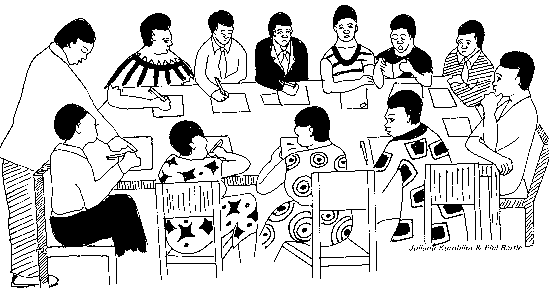
Image via Community Empowerment Collective

The World Bank released a report in 2005 in which the authors succinctly describe five core principals of participatory decision-making that they suggested be implemented across World Bank policy and decision-making. Find these copied below. Their suggested principals could easily be applied to any governing institution. These principals applied to local, state and national governing methods, would go FAR in strengthening democracy at its core.

Click HERE to access the document in pdf.

Check it out:

Transparency and Access to Information. Effective transparency mechanisms make information available to citizens in ways that the information can influence their political choices. They provide complete information about activities and options before key decisions are made, and in local languages, culturally appropriate formats, and in ways that are readily accessible and affordable.

Inclusiveness. Inclusiveness requires that all people have the opportunity to participate in making decisions that will directly affect their lives. In particular, it involves bringing in politically disenfranchised or marginalized groups that might ordinarily be excluded from decision-making processes. This may include efforts to systematically identify all those whose rights may be affected or who may bear the risks associated with the decision; and to reach out to them and provide whatever assistance they may need to participate (e.g. translation services, travel support, etc).

Quality of Discourse and Deliberation. Deliberative processes allow affected people to freely and equally express their competing interests, perspectives, and visions of the public good. For decision-making to be based on deliberation rather than raw political power, marginalized stakeholders must be enabled to participate on an equal basis with more entrenched interests. Thus, where contested issues are highly technical, all participants should have comparable access to the expertise necessary to independently challenge the technical claims of other parties. Participants must also have the option to withhold their consent to an agreement if their concerns are not adequately addressed.

Fairness under Rule of Law. Fairness requires that both the process and its substantive outcomes comport with shared principles of justice and equity. Procedural fairness requires that policies, rules and standards be developed and enforced in impartial and predictable ways, and that processes of representation, decision-making and enforcement are clear, mandatory and internally consistent. Substantive fairness requires that the distribution of costs, benefits and risks from policy outcomes are just and equitable.

Accountability. Accountability implies that decision-makers must answer for their actions and, depending on the answer, be exposed to potential sanctions. Accountability mechanisms allow citizens to control the behavior of government officials and representatives to whom they have delegated public power. Effective accountability mechanisms require compliance and enforcement. Compliance involves evaluating their actions against clear standards that are based on publicly accepted norms. These include both procedural standards (regarding transparency, inclusiveness, etc.) and standards for assessing outcomes (e.g., on poverty reduction, social equity, and human rights). Enforcement involves imposing sanctions for failing to comply with those standards.

These principles can help to structure participatory, responsive and predictable decision-making processes that can lead to better, more sustainable development outcomes by reconciling competing interests and visions of the public good through deliberation and negotiation. To do so, they must be applied with an eye towards redressing the profound inequities of voice, access and political power between different interests in development debates. If they are applied in this way, they can be powerful tools to enhance the capacity of poor and marginalized people to influence the decisions that affect their lives. If they are not, they are unlikely to improve outcomes very much.

Tuesday, July 17, 2012

Genetic Modification as the Future of Food?

The speaker in the video below doesn't seem to think so. The video talks about the process of genetically modifying a seed and criticizes the increased planting of these seeds around the world. Viewers should note that the speaker is an Englishman. He says 'this country' a few times in the video, and is referring to England. Also, I believe the video was shot a few years ago. Regardless, the content is interesting and remains relevant today.


Saturday, June 9, 2012

One Love: Human Interconnectedness

Went to see an amazing live music performance last night by Balkan Beat Box (BBB).

WOW. Beautiful music.

BBB in many ways embodies the idea of 'local to global'. Their music fuses sounds from so many different places, cultures and times. They perform all over the world. And their music deals with issues and themes faced in many places in the world - police brutality, constant war and how it can be ended, political violence and lack of freedom, interconnectedness of humans everywhere.

I am pasting some of their music below. Please check them out! Enjoy!


Part of the Glory:


Kabulectro:


War Again:


Political F***:


Wednesday, August 24, 2011

TODAY! // The City as a Canvas for Creative Envisioning: Generating GOOD Growth!

TODAY!

Local to Global Life Works
cordially invites you to:


The City as a Canvas for Creative Envisioning: 
Generating GOOD Growth!


Tonight, Wednesday, August 24, 2011
6:00 - 9:30 pm

*


August Monthly Meetup.


*

Located at The Last Bookstore
453 S. Spring Street, Ground Floor
Los Angeles, CA 90013


To RSVP, go to the event page:
*

* We do not inherit the Earth from our ancestors, we borrow it from our children *
- Native American proverb

"Cultural Equity: It is not our differences that divide us, it is
our inability to recognize, accept and celebrate those differences."
~ Audre Lorde

~~~~~~~~~

Dear friends and colleagues:

This month's Local to Global Life Works event is being held in conjunction with GOOD Magazine Los Angeles as a part of the GOOD LA Monthly Meetup series. This event explores "The City as a Canvas for Creative Envisioning," focusing on how to generate good growth, specifically in downtown Los Angeles.  The goal of the event is to discuss: positive things being done to create community within the rapidly burgeoning heart of Los Angeles; more things that can be done by individuals, businesses and elected officials to foster good growth initiatives downtown; challenges to generating good growth; and how such challenges can be overcome.  We will have some light snacks available and will give a free mini cupcake donated by Big Man Bakes especially for this event to the first 48 registrants!  Come prepared to brainstorm and share your visions for the future of downtown Los Angeles! 


The evening program is as follows:
6:00 - 6:15 pm // Welcome and opening meditation

6:15 - 6:45 pm // Plenary session panel featuring:
6:45 - 7:35 // Individual group breakout and discussion session

7:35 - 7:50 // Group reconvening and sharing of results from individual discussions

7:50 - 8:00 // Closing meditation and short intermission

8:05 - 9:30 // Open networking and live music from Los Angeles culture changers: 
*

Lastly, a downtown community member, Coach Ron, is collecting donations for the kids he works with as founder/director of Funzone Kids Reading Club for Skid Row youth. So if you can, please bring something from the list below: 

- Jump ropes
- Dot markers
- Paper
- Cereal
- Markers
- Clip boards
- Cornmeal
- Playdough
- Crayons
- Large paint brushes
- Puzzles
- Small table
- Mirrors
- Blank cds